134th Infantry Regiment Website
"All Hell Can't Stop Us"

|
|
134th Infantry Regiment Website"All Hell Can't Stop Us" |
|
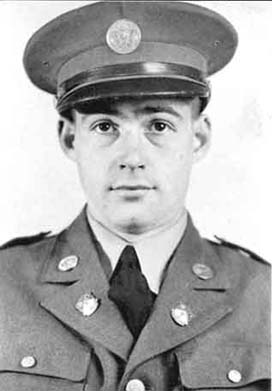
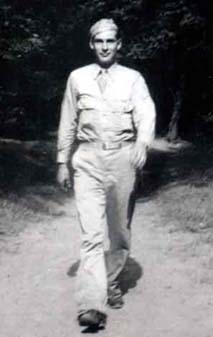
Photo of S/Sgt. Weick taken before leaving the U. S.
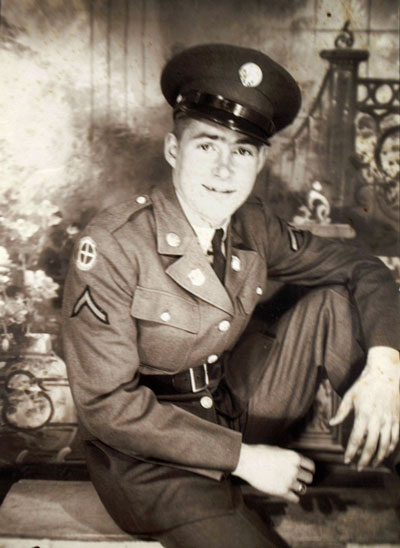
1940
|
|
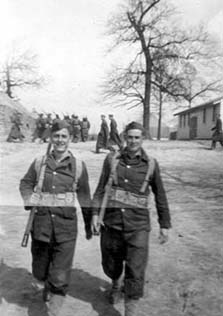
S/Sgt. Weick (on right) with an unidentified comrade |
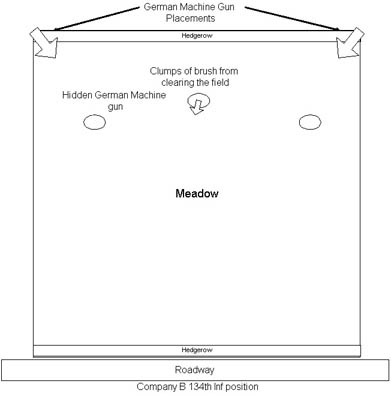
The following is the true unabridged version of what happened that day outside St. Lo. In no way does this unabridged version take away from the courage shown by my father during battle. If anything it enhances his devotion to his comrades and the will to save someone else before himself. Earthen hedgerows with brush and trees planted on them surrounded the meadows in France. In the meadows normally were piles of brush and branches cleared from the fields. The Germans would place machine guns in each corner of the fields and fire tracer bullets above the heads of the on troops. Then when the troops got into the middle of the field the hidden machine guns in the brush piles would open at waist level. Here is his account of what happened that day. I am trying to word it exactly as he told the story to me. This is a diagram of the meadow that the unit had to fight across.
CLICK HERE to see maps of the St. Lo area indicating the position of the 134th Infantry Regiment July 15 - 18, 1944
"As we approached the field we could see machine gun fire coming from the corners sweeping the entire field. We saw men down in different areas of the field and other men attacking across the field toward the machine gun nests. The 2 of us started across the field when the guns turned their attention toward another group of men. We made it within grenade distance of one nest when a 3rd hidden machine gun opened up on us from a clump of brush and branches. I remember having a grenade in my hand pulling the pin when it felt like someone hit me in the shoulder with a sledgehammer. I was knocked to the ground and my partner fell on top of me. He said "Gene I'm hit!" I could only respond "Me too."
Once we were down the machine guns turned toward other men attempting to cross the field. Any movement we made was prompted by new gunfire in our direction. My right shoulder was numb and my partner had been hit 4 times between the knees and waist. He was in very bad shape and quickly passed out. I noticed 2 of my men slowly moving toward the hidden machine nest. When the gun turned toward their direction I gathered up my comrade in my arms and headed back toward the rear hedgerow.
I heard a yell and knew the gun was turning in our direction but the bullets never came. Quickly glancing behind me I saw that the 2 men for my squad had tossed a phosphorus grenade into the brush pile making it burst into flame and silencing the machine gun. Meantime the guns on the corner of the field were swinging my way. By this time I had made it to the hedgerow.
I knew I could never get over the hedgerow with him in my arms. As I looked down I also saw that in my frozen right hand I still clutched the grenade, the pin removed. I shoved my partner over the hedgerow and with my left hand started to pry my frozen finger from around the grenade. I could not go over the hedgerow with a live grenade in my hand because if it went off many of my comrades could die. I finally got my fingers loose and tossed the grenade as far as I could with my left hand, which wasn't very far. The explosion alerted the Germans to my position and brought both guns toward me. As I jumped over the hedgerow dirt and tree branches sliced down and thrown up but the German guns covered me.
A medic was on the spot attending my wounds and I saw my partner being carried off. I never saw him again. I don't know what ever happened to him. Because of my wound I was sent to England to recover. I finally returned to my unit around December 1, 1944 just before the unit crossed the river into Germany. During my recovery I was awarded the Silver Star and Purple Heart and promoted to TSgt. I returned as a platoon leader. I had a hard time finding many of my friends from the unit. We had been spread out and many were with Company C or the 101st Airborne. We finally got regrouped before we made our strike across the river into Germany. But, that is another story."
For his bravery in this action, Sgt. Weick was awarded the Silver Star Medal
|
|
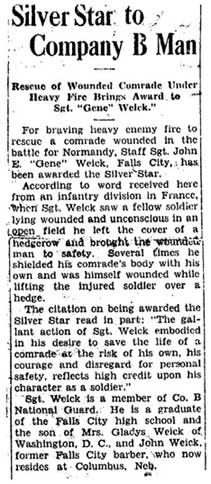
Silver Star to Company B Man For braving heavy enemy fire to rescue a comrade wounded in the battle for Normandy, Staff Sgt. John E. "Gene" Weick, Falls City, has been awarded the Silver Star. According to word received here from an infantry division in France, when Sgt. Weick saw a fellow soldier lying wounded and unconscious in an open field he left the cover of a hedgerow and brought the wounded man to safety. Several times he shielded his comrade's body with his own and was himself wounded while lifting the injured soldier over a hedge. The citation on being awarded the Silver Star read in part: "The gallant action of Sgt. Weick embodied in his desire to save the life of a comrade at the risk of his own, his courage and disregard for personal safety, reflects high credit upon his character as a soldier." Sgt. Weick is a member of Co. B National Guard. He is a graduate of Falls City high school and the son of Mrs. Gladys Weick of Washington, D.C., and John Weick, former Falls City barber, who now resides in Columbus, Neb. |
T/Sgt. Weick was also awarded a Bronze Star Medal for the heroic rescue of his wounded comrades from a minefield near Hilforth, Germany on February 26, 1945.
|
|
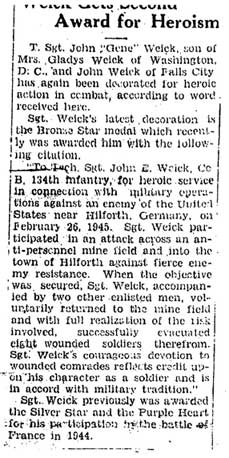
Weick Gets Second Award for Heroism Tech. Sgt. John "Gene" Weick, son of Mrs. Gladys Weick Washington, D.C., and John Weick of Falls City has again been decorated for heroic action in combat, according to word received here. Sgt. Weick's latest decoration is the Bronze Star medal which recently was awarded him with the following citation. "To Tech. Sgt. John E. Weick, Co B, 134th infantry, for heroic service in connection with military operations against an enemy of the United States near Hilforth, Germany, on February 26th, 1945. Sgt. Weick participated in an attack across an anti-personnel mine field and into the town of Hilforth against fierce enemy resistance. When the objective was secured, Sgt. Weick, accompanied by two other enlisted men, voluntary returned to the minefield and with realization of risk involved, successfully evacuated eight wounded soldiers there from. Sgt. Weick's courageous devotion to wounded comrades reflect credit upon his character as a soldier and is in accord with military tradition." Sgt. Weick previously was awarded the Silver Star and Purple Heart for his participation in the battle of France in 1944. |
Supplied by Steven Weick as told by his father John E. "Gene" Weick.
My father related this story to me in the summer 1992 while we were in Falls City for a family reunion. This was the first time I had ever been to Falls City. We visited the courthouse and the memorial for the men who gave their lives in the war. My father pointed out all the names of his hometown friend that were on the memorial.
This incident where he won the bronze star is detailed in the unit history book "134th Infantry Regiment Combat History of World War II" , (Chapter 10 of the book). John Weick was a Platoon Sgt. at this time and lead his platoon against the town. He said he lost 9 men going across the minefield. After achieving their objective and securing the town he and his men returned to the minefield to gather his wounded. At the minefield he was told that he could not enter the field until the minesweepers arrived to clear the field. They were not scheduled to arrive until the next morning. Meanwhile he had eight wounded men in the field that would not last the night. He asked for permission to enter the field and retrieve his men. After much debate he was granted permission. Two members of his platoon volunteered to assist him on retrieving the wounded from the field. These 3 men repeatedly entered an active minefield and recovered all their fallen comrades.
John Weick related this story of the retrieval of one of the soldiers from the minefield.
"The soldier was a young 19-year-old replacement from Louisiana. Heaven help me if I can remember his name. Over the years the names have faded but the faces will live with you forever. When he joined my unit I like him right off. He was bright, funny and had bright red hair. He was also very fast because he was a track star in high school. When I got to where he lay in the minefield he was in shock. I bent to pick him up and realized that both of his legs were basically gone from the knees down. He never said a word or showed that he was in any pain. As I started to carry him from the field I started to cry. By the time I got to the medics I once again had myself in control but everyone could tell how much it had affected me. I placed him in the care of the medics and returned to get another of my men. By the time we had got all of our men from the minefield it was time to move out. I never saw that brave young man again."
S/Sgt. Weick's Silver Star Medal Citation
|
Staff Sergeant John E. Weick, 20721741, Infantry, United States Army, for gallantry in action, in the vicinity of ***, Normandy, France, 17 July, 1944, Seeing a comrade lying wounded and unconscious in an open field near a hedgerow, exposed to heavy concentrations of enemy machine gun, mortar and artillery fire, and believing that further injury might befall the wounded man while in this dangerous position, Sergeant Weick crawled over a hedge into the field and proceeded to withdraw the wounded man to a position of safety. Forced to stop several times due to heavy concentrations of fire, Sergeant Weick shielded his comrade's body with his own, and was himself wounded while attempting to lift the injured soldier over a hedge. The gallant action of Sergeant Weick embodied in his desire to save the life of a comrade at the risk of his own, his courage and disregard for personal safety, reflects high credit upon his character as a soldier. Entered military service from Nebraska. |
|
|
|
|
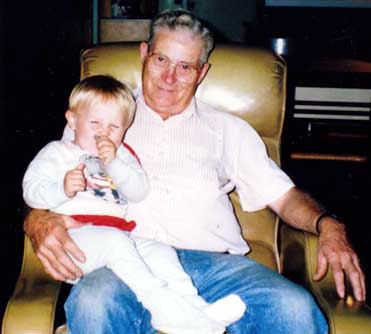
T/Sgt. John E. "Gene" Weick, with grandson Bruce John Weick, 1992 |
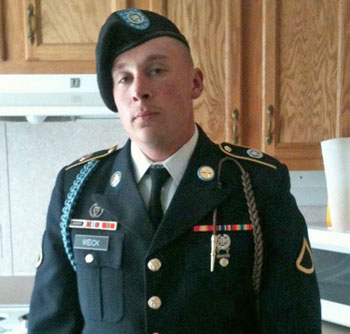
Pfc. Bruce John Weick, 2011 |
T/Sgt. John E. "Gene" Weick passed away on January 5, 2012, one day short of his 93rd Birthday.
|
John Eugene (Gene) Weick of Lookingglass, Oregon, devoted husband of Bonnie Jean (Gourley) Weick, died peacefully at the Rose Wood Nursing Center following a brief illness on Thursday, January 5, 2012. Born January 6, 1919, on his mother's nineteenth birthday, in Shubert Nebraska, Gene was the son of the late Gladys Josephine (Henderson) and the late John Phillip Weick. He was raised in Fall City where he attended school. He was a member of the Fall City High School football and basketball team, and a graduate of the Class of 1939. Gene proudly joined the National Guard on October 29, 1940, and was called to active duty in December of that year. He was attached to the Company B, 134th Infantry Regiment, 35th Infantry Division. Company B was the local Falls City National Guard unit. On July 6, 1944, while serving as a squad leader, his Division landed on Omaha Beach. His unit entered combat at the battle of St. Lo on July 15th. On July 17th, in the hedgerows outside St. Lo, he was wounded. He later was awarded the Silver Star and Purple Heart for his heroic actions during the liberation of St. Lo. After recuperating in England, he returned to his unit on December 31, 1944, where he was promoted to Platoon Sergeant. With his unit, he fought through the Battle of the Bulge and across Europe into Germany. On February 26, 1945, he was awarded his second medal for heroism, a Bronze Star, for repeatedly entering a mine field to retrieve his wounded men. After the war he served with the Occupation Army in Germany and liberated numerous Polish and Russian work camps. He also was attached to a unit assigned to track down escaping German S.S. officers that were later charged with war crimes. On August 5, 1945, he returned home and was discharged on August 9, 1945. In 1947 he moved to Shenandoah, Iowa, to follow work as a butcher, and this is where he met his wife Bonnie Jean, whom he shared 64 years of marriage. In 1950 they moved to the Roseburg, Oregon, area, and raised their four children, later settling in Lookingglass. He worked at the Sun Stud Lumber Mill in Roseburg retiring after 25 years. He often worked a second job as a butcher while he and Bonnie raised their family but he tended to his farm up until a year prior to his death. In 1993 Gene traveled with his son, Steve, to Nebraska for the first time in over 40 years for a family reunion. It was a trip of a lifetime. In the mid eighties he and Bonnie established the Winston-Dillard Food Pantry and in 1986 and awarded a Humanitarian of the Year Award by the Winston-Dillard Chamber of Commerce. Later Gene and Bonnie volunteered much of his time traveling to Portland and Eugene to gather bread to distribute to the local food pantries. He was an active member of the Winston-Dillard Methodist Church and a member of the American Legion Post 16 in Roseburg. In addition to his beloved wife, Bonnie, Gene is survived by his sister, Margorie Fellows and brother-in-law, William Fellows of Creston, Ohio, four children, Sandy Lynn Leavitt of Bluffton Indiana, Dennis Ray Weick and daughter-in-law, Carrie (Spires) Weick of Roseburg, Steven Eugene Weick and daughter-in-law, Ruth (Barr) Weick of Peabody, Massachusetts, and Randy Phillip Weick of Roseburg. Nine loving grandchildren, Greg and Kevin Murray, Lissah, Dustin and PFC Bruce Weick, Kaley Whitehead, Sabreena Morgan, Eric Stauder, and Tim Martin and nine adoring great-grandchildren and several nieces and nephews. Graveside service at the Lookingglass Cemetery at 11 a.m. Thursday, January 12th, 2012. In lieu of flowers, please make donations to the Wounded Warrior Fund in his name. |
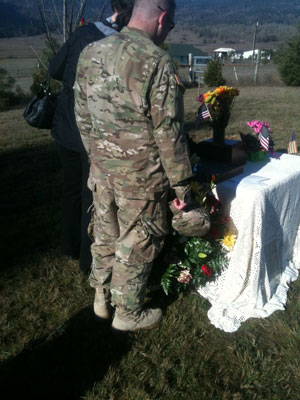
Soldier to soldier - Pfc. Bruce John Weick saying goodbye to his grandfather.
Pfc Bruce Weick is currently serving n Bravo Company, 1st Battalion, 30th Infantry, 2nd Brigade Combat Team, 3rd Infantry Division.
CLICK HERE to watch a 4-part interview in which T/Sgt Weick describes his experiences while serving with the 134th Infantry Regiment, 35th Infantry Division, in France and Germany during WWII.
The book "I'm No Hero: Story of a WWII Soldier" is available on Amazon. It is a biography of T/Sgt Weick and his experiences in the Army during WWII.