
134th Infantry Regiment Website
35th Infantry Division Research Center
"All Hell Can't Stop Us"

|
|
134th Infantry Regiment Website35th Infantry Division Research Center"All Hell Can't Stop Us" |
|

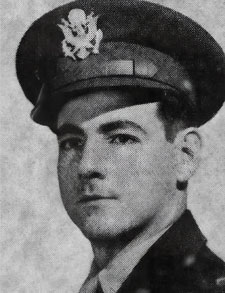
Armando Arias was born on
February 11, 1922, in Nogales, Arizona. He enlisted in the U.S. Army on October
30, 1940, and was initially stationed at Fort Bliss, Texas, and Camp White,
Oregon. After attending Officer Candidate School at Fort Benning, Georgia, he
was commissioned a Second Lieutenant on August 29, 1943.
On July 18, 1944, Arias
joined the 137th Infantry Regiment in Normandy, transferring from the 311th
Replacement Battalion while the regiment was operating near Pont-Hébert, France.
On the night of August 1, while on patrol west of Saint-Lô, he became separated
from his unit, was surrounded by German forces, and was forced to surrender. He
was taken first to a battalion command post and then to a divisional
headquarters for questioning.
On August 3, while being
moved with other prisoners to a POW transit camp, the group was strafed by U.S.
P-47 aircraft. Amid the chaos, Arias escaped, though he was nearly 20 miles
behind enemy lines. He attempted to return to Allied territory by traveling at
night and hiding in fields during the day, but was recaptured on August 5 and
transported to a transit camp in Alençon, France.
Two days later, on August 7,
the prisoners were loaded onto a train bound for Germany. When the train slowed
roughly 40 miles southeast of Paris, Arias jumped from a car under cover of
darkness. German guards fired at him but missed, and he escaped. He made his way
toward American lines, receiving help from French civilians along the way. In
one small village, residents hid him and advised him to wait until Allied forces
arrived. He remained there for 20 days, until August 29, when he contacted
elements of a U.S. armored division passing through the area.
Arias returned to duty with
the 137th Infantry Regiment on September 13, 1944. Just two days later, on
September 15, he was again captured while on a reconnaissance mission near the
Meurthe River, south of Nancy, France. After swimming the river, he emerged
directly into an enemy machine-gun position. He was taken prisoner,
interrogated, and forced to march approximately 20 miles with other captives and
guards. On the night of September 17, Arias slipped away from the group and
escaped. During his flight, he killed two guards and knocked a third
unconscious. He was sheltered by a French woman who hid him in a chicken coop
and gave him food. After two days, he moved due to heavy German presence in the
area and finally encountered an American patrol on September 20, returning once
again to his unit.
After World War II, Arias settled in Los Angeles with
his wife, Emma, and their three children. In July 1950, he was recalled to
active duty for the Korean War and served as a First Lieutenant with the 1st
Cavalry Division. On November 30, 1950, while leading an advance intelligence
and reconnaissance patrol during fierce fighting against massive Chinese
Communist forces, he was reported missing. The battle took place under brutal
winter conditions, with temperatures plunging to −30 degrees Fahrenheit. Though
capture was suspected, his fate remained unknown until December 1951, when North
Korea officially listed him among American prisoners of war.
Arias was held at Pyok-Dong
POW Camp No. 2 near the Yalu River, one of the harshest POW camps of the Korean
War. Prisoners there endured forced labor, extreme cold, disease, malnutrition,
and relentless psychological pressure. Approximately 40 percent of the American
POWs held at Pyok-Dong died in captivity.
The Korean Armistice
Agreement, signed on July 27, 1953, ended active fighting and established the
Demilitarized Zone, though the war itself was never formally concluded. The
agreement also provided for the exchange of prisoners. On September 5, 1953,
First Lieutenant Armando Arias was released at Panmunjom. He was among 290
American POWs repatriated aboard the transport General R. L. Howze, which
arrived in San Francisco on September 23, 1953. Newspaper accounts noted that
Arias was the first man to step off the ship.
He remained in the Army
after the war and retired on January 9, 1963, with the rank of Major.
|
134th Infantry Regiment & 35th Infantry Division Research Center Home Page |